
Short answer, in plain words. A grow light is a heater that also makes light. Every watt you plug in ends up as heat in your room, and it doesn't matter whether the light is LED or HPS. In fact it doesn't matter what you plug in at all: a light, a computer, a TV or a space heater. A good LED isn't a "cool" light. It's a light that makes more light from each watt, so you can plug in fewer watts for the same light, and fewer watts means less heat and a smaller bill. The very best LEDs make about 3 units of light per watt (µmol/J), and the best HPS makes about 1.7, so a top LED needs about 40% less power, not half. Most cheap panels are nowhere near the best ones. Check the numbers before you believe the box.
The deeper version. 1 W of electrical power equals 3.412 BTU/h of heat [1], and the light a lamp makes turns into heat too once leaves, walls and the floor absorb it [2]. LEDs change the form of the heat (less radiant infrared on the canopy, more convective heat at the heatsink) and where it shows up, not the total per watt [3][4]. Independent tests put double-ended HPS at 1.66–1.72 µmol/J [5][6]. Only a small top tier of LED fixtures reaches 3 µmol/J or more (about 6% of the DLC list in early 2022) [7]. GenetixBay's house position, from the founder's years sourcing from Shenzhen suppliers [8]: the LED advantage is real only in the top tier, and the panels most home growers actually receive often carry inflated wattage, vague or fake diode claims, overdriven chips and weak drivers. Those tricks have their own guides in this series.
Part of the series: LED grow lights, properly. 1. LED vs HPS: the heat and power-bill myth · 2. Samsung LM301B vs LM301H, bins and fake chips · 3. LED drivers explained · 4. How much grow light your space needs
LED vs HPS at a glance
| Double-ended HPS | Top-tier LED | Typical budget LED panel | |
|---|---|---|---|
| Fixture efficacy, independent tests | 1.66–1.72 µmol/J [5][6] | 3.0+ µmol/J (about 6% of DLC list, 2022) [7] | Often unknown; DLC minimum is 2.5 µmol/J [9] |
| Heat per wall watt | 3.412 BTU/h [1] | 3.412 BTU/h [1] | 3.412 BTU/h [1] |
| Lighting power for 1,000 µmol/s of light | ~590 W | ~333 W at 3.0 µmol/J | ~400–500 W at 2.0–2.5 µmol/J |
| Where the heat goes | 20–22% of input as near-infrared radiation; lamp runs ~150 °C (302 °F) [3] | 0–2% near-infrared; mostly convective from the heatsink [3] | Same as LED, but hotter fixture if the heatsink is small (founder's field experience) [8] |
| Leaf temperature vs air | Near or above air [4] | Usually 1–3 °C (2–5 °F) below air [4] | Same |
| Light loss over time | Lamps lose output; replaced | Slow if run cool and within spec [6][10] | Faster if overdriven or hot [6] |
| Up-front cost | Low (qualitative) | High (qualitative) | Low to medium (qualitative) |
GenetixBay does not publish prices. "Low" and "high" here are relative.
Do LED grow lights produce less heat than HPS?
No, not per watt. Every watt a grow light draws from the wall ends up as heat in the room: 1 W = 3.412 BTU/h, whether it's LED, HPS or a toaster [1]. A 600 W LED and a 600 W HPS each add about 2,047 BTU/h, and a 1,000 W fixture of either type adds about 3,412 BTU/h. Established.
This is the first law of thermodynamics applied to a closed room. Energy isn't destroyed, and the electricity has nowhere else to go. Air-conditioning load guides treat the full input wattage of lighting (lamps plus ballasts or drivers) as heat gain to the space [2].
The light is not an exception. Photons that hit leaves, walls and the floor are absorbed and become heat [2]. Plants store only a small slice of it as chemical energy: the theoretical maximum for converting solar energy to biomass is about 4.6% for C3 plants like cannabis, and real crops store far less [11]. Some of the absorbed energy evaporates water from leaves (transpiration), which shows up as humidity your dehumidifier then has to pull out, releasing that heat again.
It doesn't matter what you plug in
Every watt drawn from the wall ends up as heat in the room, whatever the device: an incandescent bulb, an HPS lamp, an LED panel, an infrared or fan heater, a computer, a TV, a phone charger, a pump or a fan [1][2]. Cooling-load guides count the electrical input of lights, appliances and office equipment as heat gain to the space for exactly this reason [2]. Established.
So a 600 W computer and a 600 W space heater heat a room the same, about 2,047 BTU/h each [1]. The heater is simply honest about it: its only job is the step every other device ends with anyway.
The only "where" that matters. Heat lands where the energy is finally dissipated, not where the brand or the box says. That gives you exactly three ways to move it:
- Put the hot part somewhere else. A remote LED driver or an HPS ballast mounted outside the tent puts its own losses (a few percent for a good LED driver [12], more for a ballast) outside the tent, though still in the room if it hangs on the wall next door.
- Let the energy leave the room. Light escaping through a window, or warm air pushed out by the exhaust fan, takes its share of the energy with it. That is what cooling is.
- Plug in fewer watts. The only way to make less heat in the first place.
The type of device, its brand or the colour of its light don't change the total.
Plain-words version: a 600 W light is a 600 W heater, whatever it says on the box.
- 3.412 BTU/hper watt from the wall, any device
- ≈ 2,047 BTU/h600 W: LED, HPS, computer or heater
- ≈ 3,412 BTU/h1,000 W, whatever it is
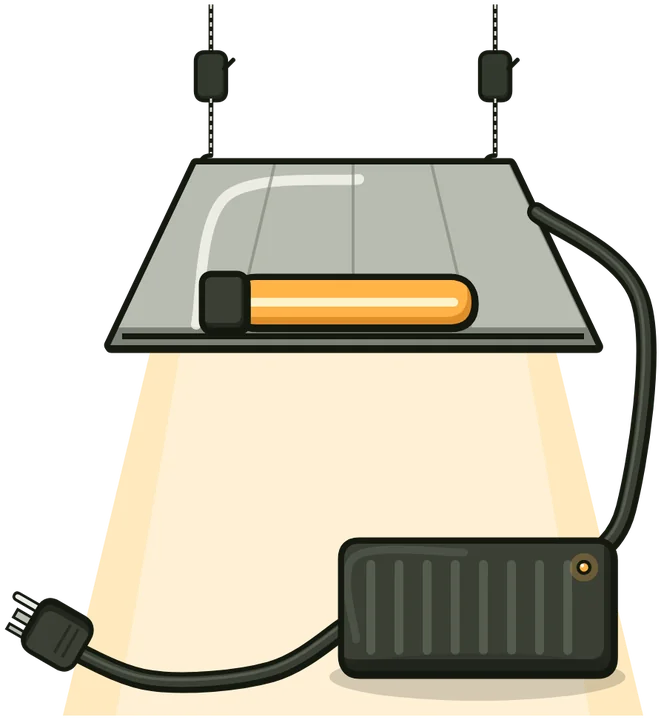
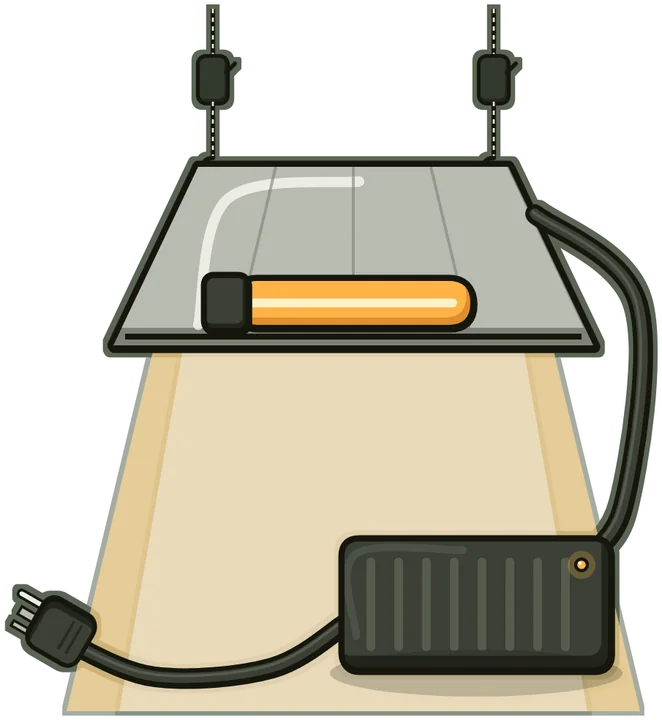 Wall wattsWhat your meter reads
- Driver or ballast lossA few percent for a good LED driver
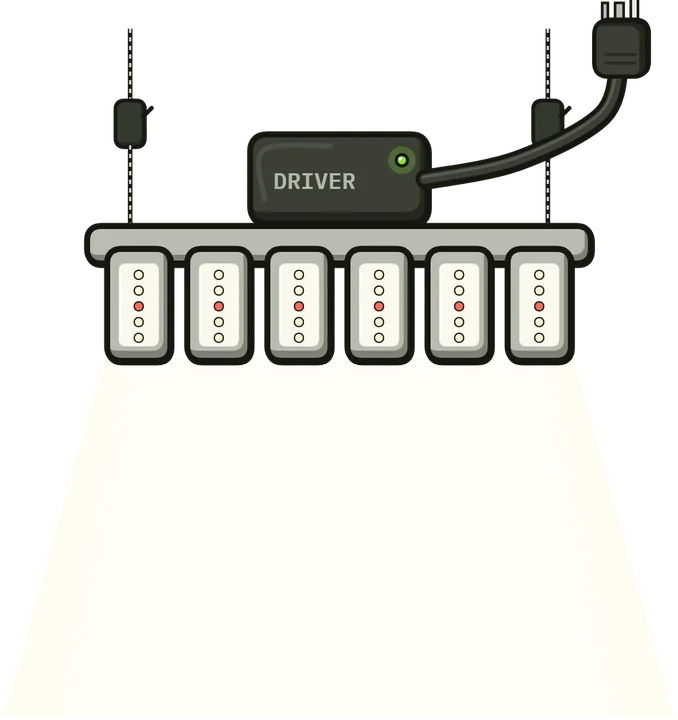
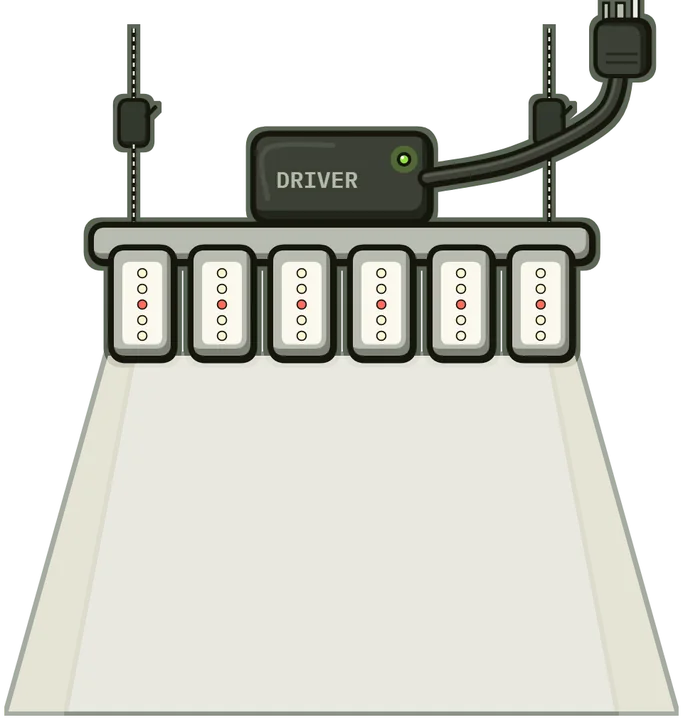 Diodes or lamp make light
- Light absorbedLeaves, walls, floor
- Heat in the room3.412 BTU/h per watt
So why does an LED room feel cooler?
An LED room feels cooler at the canopy because LEDs put far less radiant heat on the leaves, not because they make less heat per watt. HPS lamps turn about 20–22% of their input into near-infrared radiation and run at about 150 °C (302 °F); LEDs turn 0–2% into near-infrared and shed most of their heat as convection from the heatsink [3]. Established.
Radiant heat travels straight to the leaf, like sunshine on your skin. Under HPS, leaves sit near or above air temperature; under LED, a healthy, transpiring leaf usually sits 1–3 °C (2–5 °F) below the air [4]. That is why LED rooms are usually run warmer (see Should I run my room warmer with LEDs?).
The heat is still there. It's in the air above and around the fixture, and your exhaust or air conditioner has to remove it either way [3]. An LED fixture without active cooling can run its heatsink around 55 °C (131 °F) [3].
What actually lowers your heat load: fewer watts at the wall. An LED only reduces your room's heat when it delivers the same light with fewer watts, which brings us to efficacy.
Do LEDs really cut your power bill in half?
Only against old technology. A top-tier LED at 3.0 µmol/J needs about 43% less power than a double-ended HPS at 1.7 µmol/J for the same light; a 2.5 µmol/J fixture needs 32% less; a 2.0 µmol/J panel only 15% less. "Half" is only true against old single-ended (mogul-base) HPS at about 1.02 µmol/J [5]. Established (arithmetic on independent test data).
- 43%Top-tier LED, 3.0 µmol/J
- 32%DLC minimum, 2.5 µmol/J
- 15%Poor panel, 2.0 µmol/J
- 3.4 µmol/JWhat 'half the bill' would needBest-case potential
The math is simple: watts needed = light wanted (µmol/s) ÷ efficacy (µmol/J). Saving against HPS = 1 − (1.7 ÷ LED efficacy).
| Fixture | Efficacy (µmol/J) | Watts for 1,000 µmol/s | Heat (BTU/h) | Saving vs DE HPS |
|---|---|---|---|---|
| Mogul-base HPS | 1.02 [5] | 980 W | 3,345 | (uses 67% more) |
| Double-ended HPS | 1.70 [5][6] | 588 W | 2,007 | baseline |
| Poor LED panel | 2.0 | 500 W | 1,706 | 15% |
| DLC V3.0 minimum | 2.30 [13] | 435 W | 1,484 | 26% |
| DLC V4.0 minimum | 2.50 [9] | 400 W | 1,365 | 32% |
| Good LED | 2.7 | 370 W | 1,264 | 37% |
| Top-tier LED | 3.0 | 333 W | 1,137 | 43% |
| Half the power of DE HPS | 3.4 | 294 W | 1,004 | 50% |
To truly halve the power of a double-ended HPS for the same light, an LED would need about 3.4 µmol/J. That is Kusuma, Pattison and Bugbee's best-case potential estimate for white-plus-red fixtures [6].
Two more catches. First, the saving only exists if you run the LED at the same light level. Growers who swap a 1,000 W HPS for 1,000 W of LED "to get more light" have exactly the same heat load and the same bill [1]. Second, lighting is only part of the bill; cooling and dehumidifying scale with the watts you plug in [2]. For a full cost walk-through see electricity cost of growing.
Where does the "LEDs make less heat" claim come from?
It comes from replacing an HPS with fewer LED watts. A top-tier LED panel of about 240 W really can match the light of a 400 W HPS, and 240 W makes about 40% less heat than 400 W [1]. The LED didn't make less heat per watt; it used fewer watts. Established (arithmetic).
Here's the math for a 3 × 3 ft (0.84 m²) space, assuming about 85% of the fixture's photons land on the canopy in a reflective tent (an assumption; real values depend on the tent and hanging height):
| Fixture | Watts | µmol/J | PPF (µmol/s) | Average canopy PPFD (µmol/m²/s) |
|---|---|---|---|---|
| 400 W HPS | 400 | 1.7 [5] | 680 | ~690 |
| 240 W top-tier LED | 240 | 3.0 [7] | 720 | ~730 (matches the HPS) |
| 240 W mid-tier LED | 240 | 2.6 | 624 | ~635 (8% less) |
| 240 W budget LED | 240 | 2.3 | 552 | ~560 (19% less) |
| 400 W mid-tier LED | 400 | 2.6 | 1,040 | ~1,060 |
| 400 W top-tier LED | 400 | 3.0 | 1,200 | ~1,220 |
PPFD = PPF × 0.85 ÷ 0.836 m². The HPS figure uses lamp-rated watts; a magnetic ballast adds its own losses at the wall.
The house advice: swap watt for watt. Experienced growers who know top-tier gear still generally recommend replacing HPS watt for watt for the best results, unless you're buying genuinely top-tier fixtures: a 400 W HPS becomes about 400 W of LED (GenetixBay house position; founder's field experience) [8]. The table shows why: 400 W of a mid-tier LED gives about 50% more light than the 400 W HPS it replaced, while 240 W of the same LED gives less. You keep the heat load you already handle and turn it into more light, and more light means more yield [14].
Are you underlighting your tent after switching to LED?
Many growers are, and leave yield on the table. Cannabis flower yield kept rising linearly up to about 1,800 µmol/m²/s in a controlled trial [14]. GenetixBay's house recommendation is to oversize and dim: about 50 W/ft² of dimmable LED capacity, which for a 4 × 4 ft tent means 800–900 W. The common 240–400 W advice for a 4 × 4 can work, but the plants can use far more light than that; the science is in 800 W in a 4 × 4 isn't overkill. For a PR run, it's underkill by a mile. In the founder's words, the growers who follow this advice are "pulling 2.5 grams a watt" (founder's field experience) [8]. The capacity is ramped up as the plants, the climate and the grower allow. The targets by stage, the watts-per-square-foot table, the 4 × 4 worked example and how to ramp safely are in How much grow light your space needs.
How efficient is HPS, really?
In independent tests, the best double-ended HPS fixtures measured 1.66–1.70 µmol/J (Nelson and Bugbee 2014) [5], and a 1,000 W double-ended HPS measured 1.72 µmol/J in a later independent test cited by Kusuma and colleagues [6]. Old single-ended mogul-base HPS measured 1.02 µmol/J [5]. Established.
You will also see HPS figures around 2.0–2.1 µmol/J. These come from manufacturer lamp ratings. For example, a 1,000 W double-ended lamp rated at about 2,100 µmol/s gives 2.1 µmol/J against the lamp's 1,000 W, or 2.01 µmol/J against the fixture's 1,045 W input [15]being reviewed. Those figures count photons leaving a bare lamp and ignore reflector losses, so they flatter HPS the same way unverified panel claims flatter LED. Fixture-level independent numbers are the fair comparison.
DLC's V3.0 rules (2023) set the LED minimum at 2.30 µmol/J, described as 35% above the most efficacious non-LED fixture, the 1,000 W double-ended HPS [13][16]. That also implies about 1.7 µmol/J for the best HPS.
Plain-words version: the best HPS makes about 1.7 units of plant light per watt. Remember that number.
How efficient are LED grow lights, really?
Independently tested LED fixtures range widely. In early 2022 the DLC's horticultural list ran from 1.81 to 3.69 µmol/J across 600+ products; over half reached 2.5 µmol/J, but only about 6% reached 3.0 µmol/J [7]. Established.
DLC listing requires the fixture's light output and efficacy to be measured to a published test method, with reported data, and certification to UL 8800 by an accredited body [17]. That's why the DLC list is the best public check on a claimbeing reviewed.
The bar keeps rising. DLC V4.0, effective 18 April 2025, raised the minimum by 8.7% over V3.0's 2.30 µmol/J, which is about 2.5 µmol/J [9]. The physics ceiling is near: Kusuma and colleagues estimated about 3.4 µmol/J as the best-case potential for white-plus-red fixtures and 4.1 for blue-plus-red [6].
Let's not kid ourselves: old and low-end LEDs are often worse than HPS. In the 2014 independent tests, ten LED fixtures measured 0.89–1.70 µmol/J, and eight of them were below the best double-ended HPS at 1.70 [5]. Older-generation and "blurple" panels and no-name boards of low-bin diodes driven hard still sit around 1.3–1.7 µmol/J in the founder's experience [8]. Today's DLC-listed fixtures start higher, at about 1.81 on the 2022 list [7].
Top-tier fixtures exist. Retailers list several Horticulture Lighting Group (HLG) fixtures as DLC-listed at about 2.9–3.1 µmol/Jbeing reviewed. In the founder's account, HLG was certified early and was given first pick of top Samsung bins (founder's field experience) [8]. We could not find a public source for the bin-allocation claim.
The catch: a fixture's efficacy depends on the whole build, not the diode's name. In Kusuma's worked example, a typical fixture delivers only about 67% of its diodes' datasheet efficacy once drive current, heat, driver and optics losses multiply (0.90 × 0.90 × 0.90 × 0.92), while a near-best build delivers about 93% [6].
What do LEDs and HPS each do well, and badly?
Neither technology is a magic fix. Here are the honest trade-offs.
| Pros | Cons | |
|---|---|---|
| Double-ended HPS | Cheap to buy (qualitative); proven over decades; simple, standard parts; radiant heat helps in cold rooms and winter greenhouses [3]; fixture-level efficacy is well documented [5] | About 1.7 µmol/J at best [5][6]; radiant heat on leaves limits how close it hangs and pushes leaf temperature up [4]; lamps lose output and must be replaced; lamps contain mercury and need proper disposal [18]; not dimmable on most ballasts below a set minimum |
| Top-tier LED | 3.0+ µmol/J, about 40% less power for the same light [7]; little radiant heat on the canopy, so it can hang closer [3][4]; dimmable; no lamp changes; long life when run cool [6][10] | High up-front cost (qualitative); heat still has to be removed from the room [1][3]; leaves run cooler, so room settings change [4]; bright blue-rich light is an eye hazard, so wear proper glasses (IEC 62471 risk groups) [19] |
| Budget LED panel | Cheap to buy (qualitative); often better than old mogul-base HPS on paper [5] | Claims are often unverifiable; inflated wattage; vague or fake diode claims; weak drivers; small heatsinks; overdriven diodes that fade and fail early (founder's field experience) [8]; see the buyer-beware guide |
Yield and quality. Cannabis flower yield rose linearly with canopy light from 120 to 1,800 µmol/m²/s in a controlled trial [14], and efficacy matters more than spectrum for the cost of producing cannabinoids [20]. Whether HPS buds are better or worse per photon than LED buds is a GenetixBay open question: perhaps, and it's an open Bay Trial (see LED or HPS: which is better?). Contested.
Cal-Mag under LED is a Myth. LEDs don't create a calcium or magnesium need; cultivar, water source, medium and leaf temperature do (see Cal-Mag).
Quick answers on lights
- LED or HPS: which is better?
- What should I look for when buying a grow light?
- What wattage light do I need for my tent?
- Lumens vs PPFD
- Should I run my room warmer with LEDs?
- How much electricity does growing use?
- How do I cool a grow tent?
- Grow-room electrical safety
Common mistakes
- Believing an LED makes less heat per watt. It doesn't: 3.412 BTU/h per watt, every time [1].
- Swapping 1,000 W of HPS for 1,000 W of LED and expecting a cooler room or a smaller bill.
- Replacing a 400 W HPS with a 240 W "equivalent" LED in a space that already needed more light, and underlighting the canopy.
- Comparing an LED's best-case efficacy with an old mogul-base HPS.
- Keeping HPS room settings after switching to LED [4].
- Adding Cal-Mag "because it's LED" (Myth).
